IDRS
The Insurance Data Routing Standard is an decentralized mesh-like concept designed for secure and efficient data exchange between brokers, insurers, and other participants in the insurance ecosystem.
The primary goal of IDRS is to eliminate bottlenecks in data transmission, enhance process transparency, and ensure maximum security while maintaining compliance with industry standards and requirements.
Unlike traditional integration models in insurance, which rely on centralized data storage or rigid API integrations that create scalability and compliance issues, IDRS utilizes an autonomous Node-to-Node (N2N) architecture.
Dynamic self-registration of nodes
End-to-end data encryption
Flexible routing and real-time validation
Basic architecture

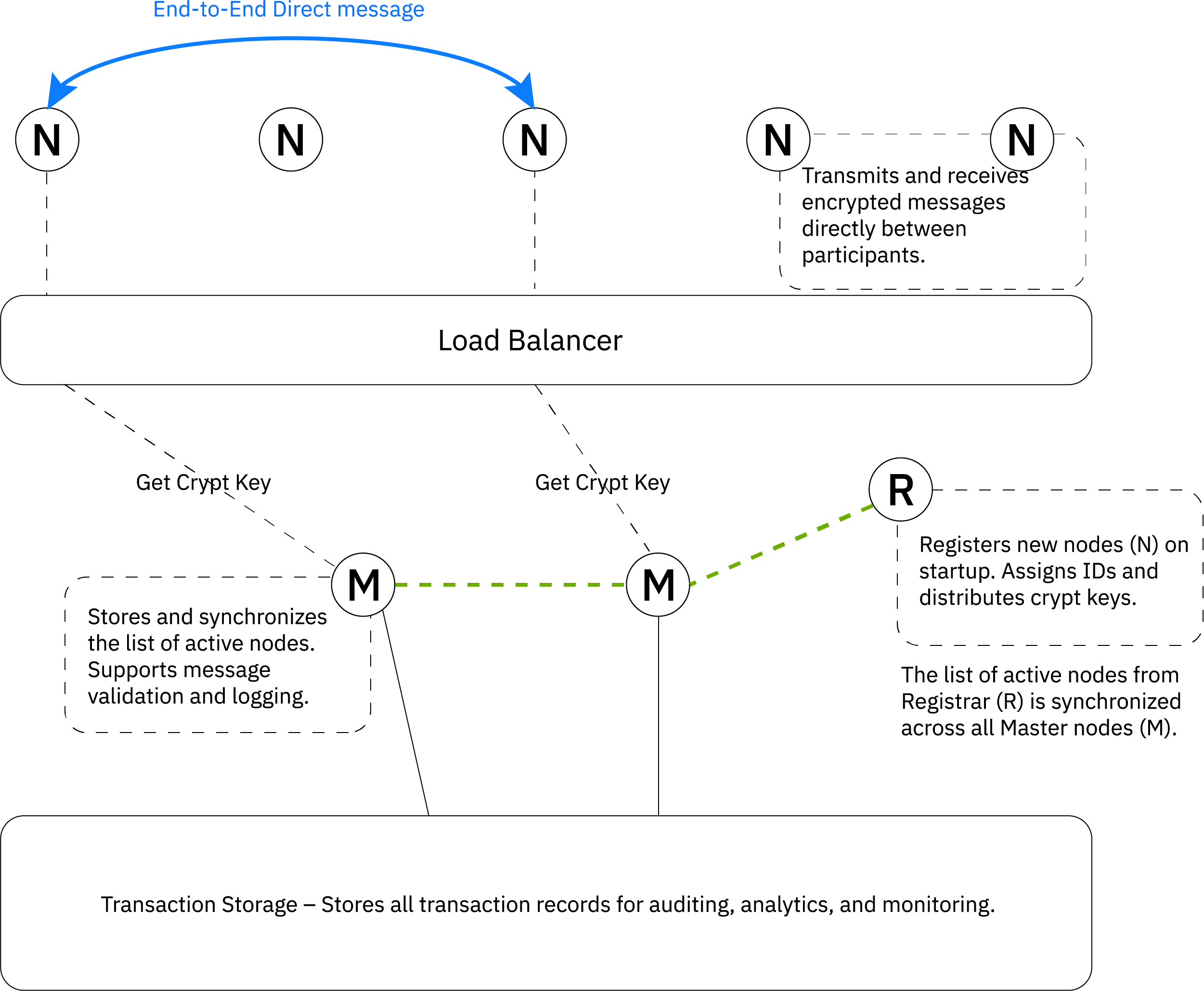
IDRS is built on a simple yet robust foundation. Each network consists of three key node types:

N (Node) – data exchange node.
M (Master) – network coordination and registration node.
R (Registrar) – participant registration and key management node.

This modular setup allows networks to scale from a few nodes to thousands, without losing speed, security, or flexibility.

IDRS vs. Leaders
IDRS is not just a technology. It is a data transmission concept that can makes the insurance market truly free, secure, and efficient.
ACORD
B3i
OPIN
IDRS
Architecture Type
Centralized (ACORD server)
Decentralized blockchain
API model (insurance companies)
Self-configuring, self-regulating network
Processing Speed
~8 messages/sec
~30 messages/sec
Depends on API of insurance companies
1K+ messages/sec
Encryption
Basic TLS
Blockchain cryptography
TLS (API)
Asymmetric encryption (RSA/ECC)
Scalability
Poor scalability
Limited by blockchain
Limited by insurance APIs
Horizontal scalability
Integration Methods
XML, SOAP
Smart contracts, API
REST, GraphQL
REST, WebSockets, P2P
Flexibility
Low (slow changes)
Medium (blockchain is rigid)
Medium (depends on API)
High (flexible routing)
Openness
Closed standard
Partially open (blockchain consortium)
Open API
Open standard (under discussion)
← Swipe β†’
πŸ“Œ Conclusion:
Features
Instant Deployment. Simple Integration.
IDRS N-Node can be deployed on any server within 5 minutes and starts working automatically.
It doesn't matter which system you need to transmit data to β€” IDRS adapts to your needs.
  • βœ… Deploys on any hardware β†’ from a local server to cloud platforms (AWS, GCP, Azure).
  • βœ… Plug-in system β†’ IDRS supports plugins for integration with popular CRM, ERP, and accounting systems.
  • βœ… Minimal requirements β†’ No need for powerful resources, IDRS even runs on a Raspberry Pi.
Plug-ins β€” easy and fast
Need integration with your system? Just install a plugin.
No need to rewrite code β†’ IDRS transmits data the way you need it.
Supported ready-made modules:
  • Guidewire
  • Duck Creek Technologies
  • Applied Epic
  • Vertafore AMS360
  • Sapiens IDITSuite
  • Fadata INSIS
  • EIS Suite
  • BriteCore
  • Insly
  • OpenText Exstream
  • SAP
  • 1C
Forget, forget...
You no longer need APIs, VPNs, and complex integrations
Forget about outdated data transmission models that require API setup, VPN, open ports, and endless approvals.
IDRS eliminates all these problems, allowing nodes to communicate directly.
  • βœ… No need for API gateways β†’ The system automatically adapts to the data format.
  • βœ… No complex VPN tunnels β†’ Data is transmitted over secure channels without needing private networks.
  • βœ… No central API control β†’ Every interaction happens within authorized node-to-node connections.
API control is no longer needed
In traditional systems, you have to configure API access, issue tokens, control permissions, and worry about leaks.
With IDRS, everything is simpler:
  • βœ… Encryption at the node level β†’ Only the sender and receiver can decrypt the data.
  • βœ… No centralized API dependency β†’ Data flows autonomously between network participants.
  • βœ… Dynamic interaction support β†’ Just connect `N`, and it starts exchanging data.
APIs become optional. You are no longer dependent on their restrictions and control policies.
X-node
By default, IDRS does not require centralized control β€” nodes exchange data autonomously, without VPNs, API gateways, or any restrictions. However, if additional control is needed, an X-Node can be integrated into the system. This element is optional and does not function as a central server. X-Node is any service operating within the network, enabling data flow monitoring, logging and traffic analysis without delays, flexible rules-based routing (e.g., by data type, nodes, or geography), analytics and reporting with integration into ClickHouse or any BI systems, as well as security and access control, including the possibility of restricting data transmission between certain N. If necessary, X-Node can be clustered, preserving the decentralized nature of the network, and its configuration remains flexible β€” you can enable X when needed and disable it when not.
Curious?
Think building a high-performance data network is expensive? With IDRS, you can assemble an incredibly powerful, resilient system at minimal cost. Scale from local setups to global networks β€” using simple, affordable components. Efficiency, not complexity. Power, not overhead.
IDRS
IDRS Beast-Mode
Number of M
1-3
1000+
Load Balancer (L)
No
Yes
Control (G)
No
Yes
Registrar (R)
Yes
Yes
Encryption
Asymmetric (RSA/ECC)
Asymmetric + Zero Trust
Annual Transactions
~1M
1B+
TPS (Transactions Per Second)
1K+
10K+
Scalability
Local
Global
Networking Technologies
REST, WebSockets, P2P
WebSockets, Kafka, NATS, P2P
← Swipe β†’

IDRS was designed with the insurance market in mind β€” to connect brokers, insurers, and partners into a fast, secure network. But its core concept is universal. Wherever independent participants need to exchange data without delays or intermediaries, IDRS fits naturally. A franchise network where every branch operates autonomously but stays in sync. A fragmented industry where competitors exchange critical updates while protecting their data. A distributed service network where local providers coordinate in real-time without a central hub. One concept. Different players. Same efficiency. That’s IDRS.

Prices
IDRS is up to 2,500 times cheaper and handles over 100,000 times more transactions than ACORD. Even at scale, IDRS Beast-Mode is 4 times more cost-effective with 1M+ times the throughput.
IDRS (1-3 Nodes)
IDRS Beast-Mode
ACORD
Annual Cost (Minimum)
$60
$36,000
$150,000
Annual Cost (Maximum)
$720
$120,000
$500,000
Transactions Per Second (TPS)
1000+
10000+
~8
Annual Transactions
~31.5B
~315B
~250K
← Swipe β†’

IDRS is not a promise of magic, nor is it a one-size-fits-all solution. It’s a concept β€” a practical approach to building fast, resilient, and low-cost data networks. Whether you need to connect a few brokers or scale across markets, IDRS adapts. No vendor lock-in, no heavy infrastructure. Just nodes, data, and control β€” when you need it.

IDRS. Because networks should work, not slow you down.

Designed by viapp.tech πŸ•ΆοΈ DARPA, call us.